Never Again
"Never leave that till tomorrow which you can do today."
- Benjamin Franklin
1. Introduction
People and politics could be defined in economic terms of demand and supply or cause and effect. Politics obtain the powers that control national organisations by the people who want to develop their ground of lives. The public want to appear their opinion about politics. Politics comment on a variety of methods, such as music, movie, speeches, and cartoons. Political cartooning is one of the ways to convey the public's desire. However, political cartoons may be a sensitive issue, because it depends on situation of cartoonists and agreement by the public. The aim of this report is to examine the key a universal definition associated with the term political cartoon, also describe reasons and examples about the definition.
2. Discussion of Political Cartoon
2.1 Composition
Political cartoons are different from general cartoons. Typically, political cartoons are composed of two aspects, which are caricature and allusion. According to Backer (1996, para. 1), caricature is individual parodies and allusion is creations of the situation or context of the placement of the individual. These aspects are shown by simple illustration and short sentences usually to express strongly. Backer (1996, para. 1) also defines that political cartoons were the "fanciful exercises" in the past. It could be before did not appear the power of the political cartoons.
In
2.3 Influence
One political cartoon has often strong powers, which show and move the public's desire. An illustration of this is "Join or Die" by Benjamin Franklin. Disconnected snake with abbreviated words represented the Colonies. This was the first American political cartoon; also it became the symbol of the American Revolution. Backer (1996, para. 5) states that "
3. Definition of Political Cartoon
3.1 Definition
Political cartoon define the visual aspects, discourse, and arguing without the need to read. One of these examples is Luther's cartoon, "Passional Christi und Antichristi" which was originally drawn by Lucas Cranach, with simple illustration and no writing. It may be for the people who could not read, and became more Christlike (Backer 1996, para. 3). Another of these examples is Steve Bell's cartoon in 1997, British. This cartoon figured one man, who wears the cellular underpants outside his trousers and is ready to fire his wick, with the title, "Election 97". In this example, "Major appears to hope the pants will act as a sort of rocket launcher, jetting him into the general election campaign" (Seymour-Ure 2001, p. 350).
3.2 Reasons
The public want to know hidden truths. Also, they want to change or turn to the right direction. These describe why political cartoons are continued within history. The author, Seymour-Ure (2001) describes continuity among cartoonists. "This combination of familiarity and predictability with a particular freshness every day is what provides a newspaper with its stability as an enterprise" (p. 337). Flows of stories in political cartoons are attractive because it seems like separated story or not connected. However, it is not comics. This means for reading or recognising political cartoons, readers should know the background of each cartoon. That is why cartoonists have expressed instead of the public by independent way.
3.3 Examples
Some of political cartoons influenced salient events of history. "Join or Die" by Benjamin Franklin became the symbol of the American Revolution, it responded the Civil War. "Mr.
4. Conclusion
Political cartoons could be defined universally because countries that have politics and no limit of expression have political cartoons. This history is long term because it is the public's desire and expression of opinions. Even though politicians do not want to be treated by cartoon, it is significant way to develop "human social".
References
Backer, D. 1996, 'A Brief History of Political Cartoon', Uniting Mugwumps and the Masses, viewed 11 September 2007, <
Seymour-Ure, C. 2001, 'What Future for the British Political Cartoon?', Journalism Studies, vol. 2, no. 3, pp. 333-355.
Tju, L.C. 2001, 'Political Cartoons in Singapore: Misnomer or Redefinition Necessary?', Journal of Popular Culture, pp. 77-83.

 "The Father of Economics", Adam Smith (1723 – 1790) was a Scottish economist and philosopher. He was born in a small town, Kirkcaldy near Edinburgh in Scotland, and was the son of the comptroller of the customs.
1. Life and Background
Adam Smith entered the University of Glasgow when he was 15 years old, studying Greek literature, mathematics, and ethics. He also studied moral philosophy under "the never-to-be-forgotten" Francis Hutcheson, a mercantilist. In 1740, he shifted to the Balliol College of the University of Oxford to study because England was stronger both in agriculture and economy than Scotland's. He met the philosopher David Hume who became one of the closets of his friends there, and was influenced by Hume's treatise, Human Nature. At the age of 25, he began delivering public lectures, rhetoric in Edinburgh, and then he assumed the professor of the University of Glasgow. In 1752, he transferred to the chair of moral philosophy that was a lecture of Smith's mentor, Francis Hutcheson. Smith's lectures covered the field of ethics, rhetoric, jurisprudence, and political economy, or "police and revenue". In 1759 he published Theory of Moral Sentiments, embodying some of his Glasgow lectures. This work gave him his reputation. At the end of 1763, he left Glasgow to become tutor to the young duke of Buccleuch, and he travelled France with his pupil from 1764 until 1766. In his travels, he came to know French physiocrats and philosophers such as Voltaire, Rousseau, and Franklin. After travelling, he devoted much of the next ten years to his magnum opus, An Inquiry into the Nature and Causes of the Wealth of Nations which appeared in 1776. He also plunged studies of philosophy, history, and politics. He was appointed the president of the University of Glasgow in 1787 and died in Edinburgh on July 17, 1790.
The period of his time was before the Industrial Revolution. Merchant capital had been growing in cities, and manufacture became as new way of production in rural communities that time. Adam Smith could be called the economist of the age of manufacture. The beginning of large-scale industrial capitalism based on division of work affected his ideas; the whole society is similar to workplace doing division of work, the manufacturing industry is also important with commercial and agriculture industries. In 1776, however, the Industrial Revolution just began when An Inquiry into the Nature and Causes of the Wealth of Nations appeared. The theory of economy which worked after the Industrial Revolution was described by Smith before the Industrial Revolution through An Inquiry into the Nature and Causes of the Wealth of Nations. It could make sure Adam Smith was the father of economics.
 2. Career and Achievements
Adam Smith studied at the University of Glasgow, and then had studied by him self at the University of Oxford for six years. This was because there was no substantial education at Oxford. On returning to the University of Glasgow, he was appointed professor of logic (1751), then the chair of moral philosophy (1752). Economics was not an independent subject yet, so it was included moral philosophy in that time. This fact could be known that Smith's ideas were the beginning of economics.
Smith published two books, Theory of Moral Sentiments (1759) and An Inquiry into the Nature and Causes of the Wealth of Nations (1776).
● Theory of Moral Sentiments
This theory was concerned with the explanation of moral approval and disapproval. From Smith's question; Why do we regard certain actions or intentions with approval and condemn others? People's opinions in the age of Smith were separated as two kinds; the law could judge what was right or wrong, and another was the moral standard which could be like mathematics formula. However, Smith presented new way of judgement within these arguments. He stated that everybody has lived with a moral sense which can see what is right or not. According to Smith, this sense called "sympathy" could be able to provide in social organisation. Thus, ethical emotion is a result of human nature, not human reason. This means that social organisation is seen as the outcome of human action but not necessarily of human design.
● An Inquiry into the Nature and Causes of the Wealth of Nations
This book became the first systematised economics book, and contributed theoretical and practical knowledge about economy. In this book, Smith claimed that free trade must be established proliferation of division of work being to increase people's wealth; he also warned monopolisation and protection in market by the Government are more harm than good. "A vast and stinging critique of the crippling regulation of commerce and trade that was then current, it argued that if people were set free to better themselves, it would – 'as if by an invisible hand' – actually benefit the whole of society" (Adam Smith Institute 2007, para. 6).
 3. Context of His Age and His Ideas
 4. Strengths or Weaknesses
References
Adam Smith Institute 2007, ‘Adam Smith’, Adam Smith Institute, viewed 29 August 2007, <http://www.adamsmith.org/smith>
Smith, A. 1759, The Theory of Moral Sentiments.
Smith, A. 1776, An Inquiry into the Nature and Causes of the Wealth of Nations.
 1. Biography
 3. Social Context of Times
North, East, West, and South; NEWS
Although the origin of the word 'news' is unknown, it could be identified that news has dealt with every event and problem. Referred to by the Collins COBUILD dictionary, news is information that is published in newspapers and broadcast on radio and television about a recently changed situation or a recent event in the country or world or in a particular area of activity. The two newspapers in this essay are The Sydney Morning Herald, a broadsheet and The Daily Telegraph, a tabloid. Both newspapers are published daily in Australia but each newspaper uses different way to convey information. This essay will compare and contrast methods of expression, news values, and key themes between both the newspapers of the same story, on the same day. Two daily newspapers, The Sydney Morning Herald and The Daily Telegraph which were published on Tuesday, 24 July, 2007, reported about an accused man who threw rocks on the freeway. According to both the newspapers, the man, Peter Hodgkins, 25, who was at home on bail, was arrested two days ago in Kiama Downs. About 3.15 am on Sunday, he throw the rocks from the end of the Princes Highway, then a traveller, Nicole Miller, 22, who was a beauty therapist, was struck by the rocks he threw that smashed through a rear side window of her friend's vehicle. After the incident, she has needed the support of a breathing machine in Wollongong Hospital because the rocks thrown by Peter Hodgkins had crushed her skull and injured her face. Both articles wrote information about the rock thrower, Peter Hodgkins. According to his own profile on MySpace, a social networking website, he is a devoted single father, loves his daughter and earns less than $30,000 a year. In addition, two articles reported how he was arrested and how he had got bail.
 Both newspapers were similar and different in their methods of expression, news values and key themes. Firstly, methods of expression such as headlines, photographs, and article's placement, are completely different between each newspaper. The Sydney Morning Herald wrote "The man accused of throwing the rock" and "The woman fighting for her life" in the headlines on the left section of the front page, and inserted photographs showing the man, Peter Hodgkins, whose face is affected as mosaic design and the woman, Nicole Miller, who is smiling without mosaic design. On page 3, The Sydney Morning Herald also wrote "At home on bail: the man accused of freeway rock attack" in the headline, and also inserted the same photograph as the front page with a sub headline, "Charged…Peter Hodgkins was arrested after a tip-off". However, The Daily Telegraph wrote a different headline which stated, "Friends shock at rock arrest" on the left section of the front page, and inserted a photograph showing Peter Hodgkins without any distortion effect. On page 5, this newspaper used the headlines, "Secrets of rock attack suspect" written by the biggest point typeface in this page and "Loves daughter, idolises dad…in deep trouble" by smaller point typeface than Secrets…'s. Moreover, there were three photographs on this page, one of these photographs showing Peter Hodgkins, which is the same photograph of The Sydney Morning Herald's but no mosaic effect and showing the half of the his body with tattoos, especially 'PAYABLE ON DEATH', and two of the photographs showed the woman and the damaged car with a broken window. Even though the two newspapers used the same photograph showing the man, their treatments are quite different. According to Sheley and Ashkins (cited in Davis 1981, p. 492), pictures of crime news presented in newspapers reflect on the public’s conception of crime. In this case, the tabloid content of The Daily Telegraph made fear and anger more than content in this article's from the man from using his smiling with the finger in contrast with the smiling woman.
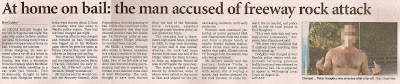 Secondly, news values of the two articles are similar. Even though the two articles were written about crime, the flow of stories followed an entertainment form. In terms of these stories, 'human interest' and 'emotional appeal' may be defined as the news values. For example, the broadsheet, The Sydney Morning Herald did not avoid typical tabloid content. In the beginning of this article, The Sydney Morning Herald wrote the facts, Peter Hodgkins was logged on to his social networking website, MySpace after being charged and his hobbies are fishing and surfing. These facts were not directly relevant and necessary in order to explain this incident in itself, but these are generally relevant to understand the context. Tabloid content that may appear in newspapers and broadcast on radio and television especially shows crimes, sex and celebrities' scandals (Lumby 1999, p. 39). The Daily Telegraph also followed tabloid content through photographs. Additionally, the attractive headlines, for example, 'Loves daughter', which were against this terrible crime, captured the attention of readers.
 Finally, the treatments of each article are also similar. Traditionally news can be separated between soft and hard news. "'Soft news' deal with human interest stories and news items considered 'interesting' or 'entertaining'. 'Hard news' deals with 'important' stories and is usually considered to contain more 'hard facts'" (Turner 2006, p. 9). Both articles treated a story focusing the one man and his victim. It is sufficient to define that both stories are soft news. People who have known this story will be afraid but it was simply an accident. There is no plan to be not a victim. As a result, these stories just seem to convey more entertaining facts rather than educational information. However, although the flow of this story is focused on one man, this news carries on hard facts. This means stories of crime still can be defined as hard news.
In conclusion, both newspapers treated the same story about an accused man who threw rocks. Even though they showed the same photographs, the ways of expression are different. Moreover, these headlines are different because both newspapers each focused on different points. It could be defined that they have different target audience. However, the story is obviously crime news as hard news, though the flow of this story seemed entertainment news.
References
HarperCollins 2003, Advanced Learner's English Dictionary, 4th edn, HarperCollins, Glasgow.
Lumby, C. 1999, Gotcha: Life in tabloid world, Allen and Unwin, St Leonards.
Sheley, J.F. & Ashkins, C.D. 1981, 'Crime, Crime News, and Crime Views', Public Opinion Quarterly, vol. 45, Elsevier North-Holland, pp. 492-506.
Turner R. 2006, 'The News', Media Analysis 1, Insearch UTS, Sydney.
This summary is not available. Please click here to view the post.