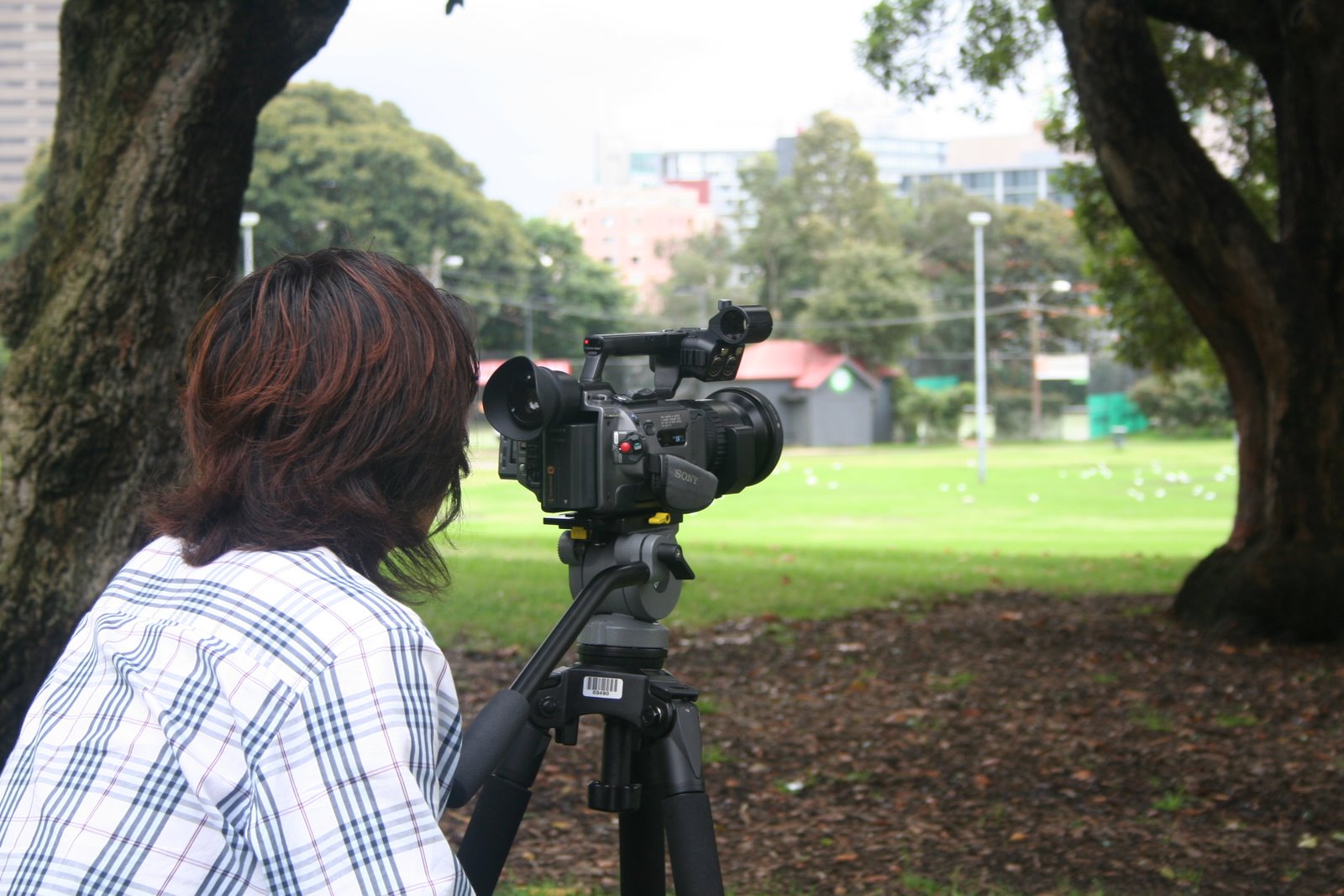
Accused: The Man Who Threw Rocks on the Freeway
North, East, West, and South; NEWS
Although the origin of the word 'news' is unknown, it could be identified that news has dealt with every event and problem. Referred to by the Collins COBUILD dictionary, news is information that is published in newspapers and broadcast on radio and television about a recently changed situation or a recent event in the country or world or in a particular area of activity. The two newspapers in this essay are The Sydney Morning Herald, a broadsheet and The Daily Telegraph, a tabloid. Both newspapers are published daily in Australia but each newspaper uses different way to convey information. This essay will compare and contrast methods of expression, news values, and key themes between both the newspapers of the same story, on the same day. Two daily newspapers, The Sydney Morning Herald and The Daily Telegraph which were published on Tuesday, 24 July, 2007, reported about an accused man who threw rocks on the freeway. According to both the newspapers, the man, Peter Hodgkins, 25, who was at home on bail, was arrested two days ago in Kiama Downs. About 3.15 am on Sunday, he throw the rocks from the end of the Princes Highway, then a traveller, Nicole Miller, 22, who was a beauty therapist, was struck by the rocks he threw that smashed through a rear side window of her friend's vehicle. After the incident, she has needed the support of a breathing machine in Wollongong Hospital because the rocks thrown by Peter Hodgkins had crushed her skull and injured her face. Both articles wrote information about the rock thrower, Peter Hodgkins. According to his own profile on MySpace, a social networking website, he is a devoted single father, loves his daughter and earns less than $30,000 a year. In addition, two articles reported how he was arrested and how he had got bail.
 Both newspapers were similar and different in their methods of expression, news values and key themes. Firstly, methods of expression such as headlines, photographs, and article's placement, are completely different between each newspaper. The Sydney Morning Herald wrote "The man accused of throwing the rock" and "The woman fighting for her life" in the headlines on the left section of the front page, and inserted photographs showing the man, Peter Hodgkins, whose face is affected as mosaic design and the woman, Nicole Miller, who is smiling without mosaic design. On page 3, The Sydney Morning Herald also wrote "At home on bail: the man accused of freeway rock attack" in the headline, and also inserted the same photograph as the front page with a sub headline, "Charged…Peter Hodgkins was arrested after a tip-off". However, The Daily Telegraph wrote a different headline which stated, "Friends shock at rock arrest" on the left section of the front page, and inserted a photograph showing Peter Hodgkins without any distortion effect. On page 5, this newspaper used the headlines, "Secrets of rock attack suspect" written by the biggest point typeface in this page and "Loves daughter, idolises dad…in deep trouble" by smaller point typeface than Secrets…'s. Moreover, there were three photographs on this page, one of these photographs showing Peter Hodgkins, which is the same photograph of The Sydney Morning Herald's but no mosaic effect and showing the half of the his body with tattoos, especially 'PAYABLE ON DEATH', and two of the photographs showed the woman and the damaged car with a broken window. Even though the two newspapers used the same photograph showing the man, their treatments are quite different. According to Sheley and Ashkins (cited in Davis 1981, p. 492), pictures of crime news presented in newspapers reflect on the public’s conception of crime. In this case, the tabloid content of The Daily Telegraph made fear and anger more than content in this article's from the man from using his smiling with the finger in contrast with the smiling woman.
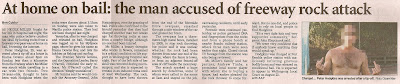 Secondly, news values of the two articles are similar. Even though the two articles were written about crime, the flow of stories followed an entertainment form. In terms of these stories, 'human interest' and 'emotional appeal' may be defined as the news values. For example, the broadsheet, The Sydney Morning Herald did not avoid typical tabloid content. In the beginning of this article, The Sydney Morning Herald wrote the facts, Peter Hodgkins was logged on to his social networking website, MySpace after being charged and his hobbies are fishing and surfing. These facts were not directly relevant and necessary in order to explain this incident in itself, but these are generally relevant to understand the context. Tabloid content that may appear in newspapers and broadcast on radio and television especially shows crimes, sex and celebrities' scandals (Lumby 1999, p. 39). The Daily Telegraph also followed tabloid content through photographs. Additionally, the attractive headlines, for example, 'Loves daughter', which were against this terrible crime, captured the attention of readers.
 Finally, the treatments of each article are also similar. Traditionally news can be separated between soft and hard news. "'Soft news' deal with human interest stories and news items considered 'interesting' or 'entertaining'. 'Hard news' deals with 'important' stories and is usually considered to contain more 'hard facts'" (Turner 2006, p. 9). Both articles treated a story focusing the one man and his victim. It is sufficient to define that both stories are soft news. People who have known this story will be afraid but it was simply an accident. There is no plan to be not a victim. As a result, these stories just seem to convey more entertaining facts rather than educational information. However, although the flow of this story is focused on one man, this news carries on hard facts. This means stories of crime still can be defined as hard news.
In conclusion, both newspapers treated the same story about an accused man who threw rocks. Even though they showed the same photographs, the ways of expression are different. Moreover, these headlines are different because both newspapers each focused on different points. It could be defined that they have different target audience. However, the story is obviously crime news as hard news, though the flow of this story seemed entertainment news.
References
HarperCollins 2003, Advanced Learner's English Dictionary, 4th edn, HarperCollins, Glasgow.
Lumby, C. 1999, Gotcha: Life in tabloid world, Allen and Unwin, St Leonards.
Sheley, J.F. & Ashkins, C.D. 1981, 'Crime, Crime News, and Crime Views', Public Opinion Quarterly, vol. 45, Elsevier North-Holland, pp. 492-506.
Turner R. 2006, 'The News', Media Analysis 1, Insearch UTS, Sydney.


 ● Index


 According to both the newspapers, they married two days ago, on Wednesday, 20 June, 2007 in Cap d’Antibes, France with guests approximately from one hundred and fifty to two hundred. There were many influential people, such as famous Hollywood actor Tom Cruise and his wife, Katie Holmes, actress, Wendi Deng who is the wife of Rupert Murdoch, the chief executive officer of News Corporation, Eddie McGuire, Channel Nine personality and PBL boss John Alexander on the list of guests.
 In addition, uninvited guests like paparazzi watched their wedding from a distance. Both articles wrote about the wedding dress of the bride, which was worth one hundred thousand Australian dollars haute couture gown and created by John Galliano of the Paris fashion house Christian Dior. This dress was produced after six-hundred to seven-hundred hours of handwork. However, Baxter ordered two dresses, one to wear at the public wedding ceremony and the second marriage ceremony.

 Secondly, news values of two articles also differed. The Sydney Morning Herald reported a summary of this wedding in order to deliver general information. As a result, this was written by moderate words. However, The Daily Telegraph focused on the bride’s wedding dress and used sarcastic words, such as ‘lavish’ and ‘splurge’, because it is able to give a feeling of satisfaction to their readers who want to know defects of powerful people. Finally, these key themes were similar. Both articles used the same key words, a wedding and a dress worth one hundred thousand Australian dollars.